

CG Policy · 2025
In this section7 topics
Corporate Governance Policy
Has a Corporate Governance Policy
Yes
Policy Description
The Company remains committed to and continuously adheres to the principles of good corporate governance, guided by the philosophy of sufficiency and good governance. The Company strives to be a transparent and accountable organization while conducting its business with due consideration for society, communities, and the environment. At the same time, the Company promotes integrity and ethical conduct among its personnel and enhances employees’ quality of work life, aiming to achieve sustainable organizational growth. To support these objectives, the Company has established the Corporate Governance and Sustainable Development Committee as a subcommittee responsible for oversight, advisory functions, and the formulation of policies and guidelines on good corporate governance and sustainable development. The Committee focuses on maintaining a balance across environmental, social, and governance dimensions (Environment, Social and Governance: ESG) to strengthen confidence and credibility among stakeholders, while supporting sustainable growth and value creation for all parties.
The Company discloses its corporate governance practices in alignment with recognized governance principles, including the Corporate Governance Code for Listed Companies 2017 (CG Code) issued by the Securities and Exchange Commission (SEC) and the Stock Exchange of Thailand (SET), as well as the Corporate Governance Report of Thai Listed Companies (CGR) criteria of the Thai Institute of Directors Association (IOD). The Board of Directors reviews governance practices annually to ensure alignment with business operations and requires regular monitoring of policy implementation to continuously enhance corporate governance standards. These practices encompass four key areas
1. Rights of Shareholders and Equitable treatment of Shareholders
2. Roles of Stakeholders
3. Information Disclosure and Transparency
4. Responsibilities of the Board of Directors
For the year 2025, the Company received a "Very Good" (4-star) rating in the annual corporate governance assessment for listed companies 2025, based on a survey of corporate governance of 844 listed companies by the Thai Institute of Directors Association. Additionally, the Company received an 84.5% score in the 2025 Annual Shareholder Meeting Quality Assessment, organized by the Thai Investors Association. This reflects that the Board of Directors has consistently prioritized good corporate governance and has regularly reviewed and updated its practices.
Policy & Practices — Board of Directors
Has Policy & Guidelines for the Board
Yes
Board Guidelines
| Guideline | Other — Please Specify | Detail |
|---|---|---|
| Nomination of Directors | Appointment of the Directors shall be determined by many qualifications such as knowledge, skills, and experience related to the business. The Nomination and Remuneration Committee is responsible for review of the qualifications and performances of the candidates in appointment of the Directors. The Board of Directors is well aware of the benefits of the diversity of the Board of Directors and has developed a Skill Matrix for the Board of Directors and focus on transparency in the nomination of the candidates, without restrictions on gender, age, education, race, nationality, religion, professional experience, skills and knowledge or any other differences. The Nomination and Remuneration Committee is responsible for review of the qualifications and performances taking into account the benefits of the diversity of candidates or directors who retire by rotation or resign. The Nomination and Remuneration Committee also considers necessary skills that are lacking in the Board of Directors in order to be in line with the Company's business strategy and propose it to the Board of Directors for an approval. After that, the list of proposed directors will be proposed to the shareholders' meeting to elect the directors. | |
| Determination of Director Remuneration | The Nomination and Remuneration Committee shall be responsible for proposing the guidelines and determining the remuneration for directors at the appropriate rate and comparable within the same industry and same business size. The survey data of the directors' compensation of the Thai Institute of Directors and the Stock Exchange of Thailand is used in consideration in determining the remuneration to the directors at the comparable rate of the same industry to motivate and be appropriated to the knowledge, ability and responsibilities of the directors. Monthly remuneration and meeting allowance for the Board of Director and Audit Committee are determined. The committee members who are members of the sub-committee will receive meeting allowance for the sub-committee as well. | |
| Independence of the Board of Directors from the Management | The Company has established a clear governance and management structure comprising five committees: the Board of Directors, the Audit Committee, the Nomination and Remuneration Committee, the Corporate Governance and Sustainability Committee, and the Executive Committee. This structure is designed to clearly segregate authority, duties, and responsibilities, thereby enhancing efficiency, transparency, and accountability in directing and managing the Company’s business operations. The Board of Directors is responsible for setting the Company’s vision, goals, and strategic direction, as well as defining roles and delegating authority to the subcommittees to support good corporate governance. Meanwhile, the Executive Committee is responsible for formulating policies, directions, and business strategies in alignment with the objectives established by the Board of Directors. The Company places great importance on establishing checks and balances within the Board to prevent management dominance and to promote effective corporate governance. According to Article 14 of the Company’s Articles of Association, the Board must consist of at least five directors who possess diverse knowledge, capabilities, and professional experience. As of 31 December 2025, the Board comprised 14 directors, including six non-executive directors (43%), two executive directors (14%), and six independent directors (43%) of the total number of directors. This composition reflects that non-executive and independent directors together account for 86% of the Board, significantly exceeding the number of executive directors. Such a structure enables the Board to perform its oversight, monitoring, and policy decision-making duties independently from management. | |
| Director Development | The Board of Directors has a policy to promote and facilitate training and knowledge provision for directors to ensure continuous improvement and performance, covering both internal and external training courses. All directors must undergo training to understand their duties as directors. The Board places importance on attending various training courses or seminars, or developing knowledge and capabilities, particularly training courses with the Thai Institute of Directors Association (IOD). In this regard, 100% of the Company’s directors have completed the Director Certificate Program (DCP) and/or the Director Accreditation Program (DAP) organized by the Thai Institute of Directors Association (IOD). | |
| Board Performance Evaluation | Director Performance Evaluation The Company conducts an annual performance evaluation of the Board of Directors and its sub-committees to assess the efficiency of the Board's operations in accordance with good corporate governance principles. This also allows the Board to review its performance, issues, and obstacles over the past year, and to utilize the evaluation results to improve the Board's duties. The evaluation criteria for both the entire Board and individual directors cover 6 topics: Board structure and qualifications, roles, duties, and responsibilities of the Board, Board meetings, performance of directors, relationship with management, and self-development of directors and executive development. Performance evaluation of the Chairman of the Executive Committee and the President The Company conducts an annual performance evaluation of the Chairman of the Executive Committee and the President at the end of each year. The Nomination and Remuneration Committee is responsible for the evaluation and presents it to the Board of Directors for approval. The summary of the performance evaluation of the Chairman of the Executive Board and the Chief Executive Officer is considered confidential personal information and cannot be disclosed. The performance of the Chairman of the Executive Board and the Chief Executive Officer is assessed based on 3 criteria: performance indicators from operational results, leadership assessment, and budget and project management assessment. The results of this evaluation will be used to determine the salary adjustment rate for the Chairman of the Executive Board and the Chief Executive Officer and will be presented to the Board of Directors for further consideration and approval. | |
| Corporate Governance of Subsidiaries and Associated Companies | The Company has established mechanisms to supervise, support, and promote the operations of its subsidiaries and joint ventures to ensure efficiency, transparency, and alignment with good corporate governance practices. The Company appoints executives to closely monitor and evaluate operational performance and assigns senior executives to serve as directors in such entities in order to ensure proper oversight and monitoring of performance, monthly reports are submitted to the Executive Committee and quarterly reports to the Board of Directors, in order to safeguard and optimize the benefits derived from the Company’s investments. In addition, the Company ensures that its subsidiaries and associated companies strictly comply with applicable laws and regulations. They are required to disclose information regarding financial position and operating results, related party transactions, acquisitions or disposals of assets, and other significant transactions completely and accurately, in accordance with the same standards applied by the Company. In the event that such transactions occur, the Company will report and submit them to the Board of Directors for acknowledgment or approval, as the case may be. This approach ensures transparent, prudent, and auditable oversight, thereby strengthening confidence among shareholders and stakeholders and supporting the sustainable growth of the Group over the long term. | |
| Other guidelines regarding the board of directors | Directorships in other companies by directors and executives | The Company allows its directors to hold directorships in other businesses, but this must not be an obstacle to the performance of duties as a director of the Company. The director should hold directorships in no more than 5 listed companies on the Stock Exchange of Thailand. In the case of the President, he/she may hold a directorship in other companies. However, it must not be an obstacle to the performance of the President of the Company and such business must not be in the same business or in competition with the business of the Company. |
Code of Conduct
Has a Business Code of Conduct
Yes
Code of Conduct Description
The Company has established guidelines on business ethics or a Code of Conduct, which compiles concepts and principles for good corporate governance that are clear, transparent, and accepted by all stakeholders. These principles, policies, and ethics are incorporated into the manual to ensure that personnel at all levels of the company, from the Board of Directors and management to employees, acknowledge and adhere to these principles. This is to meet the expectations of the company and its shareholders for operations conducted with the highest standards, and it is considered an important duty for everyone. The company will continuously monitor compliance with these guidelines and will review and update the manual annually to ensure its suitability and modernity. The company has developed a Business Code of Conduct manual for directors, executives, and employees to adhere to in their interactions with stakeholders. This Business Code of Conduct manual includes policies and practices regarding shareholders and stakeholders. (Details of the Business Code of Conduct manual are available on the company's website).
Code of Conduct Practices
| Guideline | Other — Please Specify | Detail | Document Link |
|---|---|---|---|
| Prevention of Misuse of Inside Information | Conflict of Interest Directors, executives, and employees of the Company must not have any conflicts of interest or seek personal benefits in connection with their duties and responsibilities within the Company. The Company has therefore established the following guidelines: 1. Avoid entering into transactions in which they have a personal interest that may give rise to a conflict of interest, unless such transactions are necessary for the benefit of the Company. In such cases, the transaction must be conducted on an arm’s length basis, comparable to transactions with external parties. Any person with an interest in the transaction must not participate in its consideration or approval. 2. Avoid participating in negotiations or entering into contracts as a representative of the Company with organizations in which the employee, or their relatives or close associates, have an interest. 3. Avoid accepting outside employment, providing consultancy, serving as a director, or holding shares in other entities outside the Company’s group if such activities may create a conflict of interest with the Company, unless the activities do not affect the Company’s interests and have been approved by the authorized persons in accordance with the Company’s regulations. 4. In cases that qualify as related party transactions under the regulations of supervisory authorities, such as the Securities and Exchange Commission (SEC) and the Stock Exchange of Thailand (SET), the Company must strictly comply with the prescribed rules, procedures, and disclosure requirements. Outside Business Activities Employees at all levels are prohibited from engaging in personal businesses that compete with the Company’s business, or from performing any work for the Company’s partners, competitors, customers, or potential customers that may result in direct or indirect benefits. Such activities could influence decision-making and the proper performance of duties on behalf of the Company. | ||
| Anti-corruption | The company places great importance on conducting business with transparency and adhering to good corporate governance principles. The company does not tolerate any form of fraud and corruption. To promote honest and fair business operations, the company has established the "Anti-Corruption Policy" to serve as a guideline for the operations of directors, executives, and employees at all levels, to be strictly observed and applied uniformly throughout the organization. Directors, executives, and employees of the company must not support corruption, directly or indirectly, such as giving or receiving bribes or any incentives, including assigning others to act on their behalf. Giving or receiving bribes is considered a criminal offense under criminal law, and perpetrators may face legal prosecution. Therefore, the following actions are strictly prohibited. - Paying money or providing any benefits that violate the laws of the country or the company's regulations. - Paying money or providing benefits as compensation to induce dishonest business dealings. - Paying money or providing benefits to government officials or politicians to induce them to exercise discretion in a manner favorable to the company. | https://www.ait.co.th/en/sustainability/corporate-governance/anti-corruption | |
| Whistleblowing and Protection of Whistleblowers | The company has established “Whistleblowing and Complaint Policy” To provide an opportunity for directors, executives, employees, and all stakeholder groups of the company to report clues, complaints, or suggestions regarding violations of laws, regulations, rules, or business ethics, corruption, irregularities in financial reports, or deficiencies in the company's internal control system. Whistleblowers or complainants can submit clues or complaints along with supporting evidence through various channels as deemed appropriate, as follows: 1. By email: CGSD@ait.co.th or AC@ait.co.th 2. By website: https://www.ait.co.th/en/sustainability/whistleblowing 3. By mail: Send mail to To the Chairman of the Corporate Governance and Sustainable Development Committee, or Chairman of the Audit Committee Advance Information Technology Public Company Limited 37/2 Sutthisan Winitchai Road, Samsen Nok Subdistrict, Huai Khwang District, Bangkok 10310 4. By telephone: 02-275-9400 # 3101 Secretary to the Anti-Corruption Working Group Protection and Confidentiality for Whistleblowers or Complainants The company values the privacy and security of whistleblowers or complainants and allows them to choose to remain anonymous if they believe that disclosure would lead to insecurity or any harm. However, if identity is disclosed, it will enable the company to report progress and clarify facts after the investigation. The company will keep the information of whistleblowers or complainants and related data confidential, and will not disclose it to unauthorized persons, unless disclosure is required by the company's regulations or by relevant laws, rules, or regulations. Operating Procedures 1. In cases where there is sufficient supporting evidence for the accusation or complaint, a full investigation will be initiated with the objective of ascertaining whether the alleged action actually occurred. The form of investigation will vary depending on the circumstances. The investigation will be conducted under strict confidentiality. Whistleblowers or complainants may be contacted for additional information. 2. The investigation committee will inform the whistleblower or complainant (if their identity is disclosed) of the progress and clarify the facts after the investigation results are concluded, through appropriate communication channels, and will keep all related files confidential. In important cases, the Board of Directors will be informed. 3. The Anti-Corruption Risk Management Committee will re-evaluate corruption risks to ensure adequacy and effectiveness after an investigation reveals an act of corruption. Penalties Anyone who intentionally or negligently fails to comply with this policy, including engaging in harassment, intimidation, disciplinary action, or discrimination through improper means due to a complaint made by a whistleblower/complainant or persons involved in a complaint under this policy, shall be considered to have committed a disciplinary offense. The company will consider penalties in accordance with company regulations, and if the act violates the law, the company will also consider legal action in accordance with relevant laws. False Whistleblowing or Complaints If the Company finds that the whistleblowing, complaint, or any statement or information provided is proven to be an act of bad faith, false, and intended to cause damage, in the case of an employee, disciplinary action will be taken in accordance with the company's regulations. However, if it is an external party whose actions cause damage to the company, the Company will consider legal action against such individuals in accordance with relevant laws, as appropriate for each case. Policy Review The Corporate Governance and Sustainable Development Committee will review the Whistleblowing Policy and guidelines annually and submit them to the Board of Directors for acknowledgment. If significant amendments are made to the policy, they will be submitted to the Board of Directors for approval, to ensure that the policy complies with relevant laws, is effective, and aligns with the company's regulations. | https://www.ait.co.th/en/sustainability/whistleblowing | |
| Preventing the Misuse of Inside Information | The Company has established policies and procedures governing directors, executives, and employees regarding the use of inside information and trading in the Company’s securities for personal benefit, as follows: 1. Directors, executives, and employees must maintain the confidentiality of the Company’s confidential and/or inside information. 2. Confidential and/or inside information of the Company must not be disclosed or used to seek personal gain or benefit for oneself or for others, whether directly or indirectly, and regardless of whether any compensation is received. 3. Directors, executives, and employees must not trade, transfer, or accept the transfer of the Company’s securities, or enter into any transaction using confidential and/or inside information in a manner that may cause damage to the Company, whether directly or indirectly. This requirement also applies to spouses and minor children of directors, executives, employees, and staff. Any violation of these regulations shall be considered a serious offense. 4. The Company provides knowledge and guidance to directors and executives regarding their duties to report their securities holdings, as well as those of their spouses and minor children, and the penalties stipulated under the Securities and Exchange Act B.E. 2535 (1992) and the regulations of the Stock Exchange of Thailand. 5. Directors and executives are required to report changes in their securities holdings to the Office of the Securities and Exchange Commission (SEC) in accordance with Section 59 of the Securities and Exchange Act B.E. 2535 (1992), and to submit a copy of such report to the Company on the same date the report is filed with the SEC. 6. Directors, executives, and employees who are aware of material inside information that may affect the price of the Company’s securities must refrain from trading the Company’s securities during the period prior to the disclosure of the financial statements or such inside information to the public, and must not disclose such material information to any other person. 7. The Company shall fully and accurately disclose the securities holdings of directors and executives in the Annual Report in accordance with the requirements of the Securities and Exchange Commission. | ||
| Prevention of money laundering | The Company adheres to the principles and laws related to anti-money laundering and combating the financing of terrorism to prevent directors, executives, and employees from engaging in misconduct related to money laundering, terrorism, or other financial crimes. The Company has established the following practices: 1. Before conducting transactions with a counterparty, ensure that the source of funds is legitimate. 2. Do not transfer money to unknown accounts or receive transfers with unusual payment characteristics. 3. In the event of unusual transactions, report them to your supervisor immediately. | ||
| Giving or receiving gifts, entertainment, or business entertainment | Giving Gifts, Souvenirs, or Other Benefits 1. Giving gifts or souvenirs in accordance with customary practices is permissible, provided it does not violate relevant laws and local customs. For example, in Thailand, the value should not exceed 3,000 Baht per person per occasion, as per the announcement of the NACC, and should be in a form that enhances the company's image, such as calendars, diaries, or promotional items. 2. Employees may give gifts to any person if all the following conditions are met: (1) It must not be an intentional act to influence, induce, or reward any person to gain any advantage through inappropriate actions, or a clear or hidden exchange to obtain assistance or benefits. (2) It must not constitute any illegal act. (3) It must be given on behalf of the company, not on behalf of an employee. (4) It must not be a gift in the form of cash or cash equivalents (e.g., gift cards or vouchers). (5) Appropriate for the situation, such as giving small gifts during the New Year festival. (6) The type and value must be appropriate and given at the right time and place. For example, if a business partner is in the process of organizing a tender, employees must not give gifts or entertainment to that business partner. (7) It must be given or received openly, without concealment. 3. The giving of gifts and souvenirs should be conducted uniformly to prevent discrimination. 4. Do not give gifts, souvenirs, assets, or any other benefits to spouses, children, or related parties of government officials, customers, business partners, and contacts, as such actions are deemed to be receiving on their behalf. 5. Giving souvenirs on important business occasions, such as establishment anniversaries or business contract signings, is permissible. However, if the value of the souvenir exceeds 3,000 Baht, the following actions must be taken: (1) Report immediately to the head of the department for consideration of the appropriateness and value of the souvenir. (2) Complete a Gift Declaration Form for gifts exceeding the threshold, specifying the giver's name, approximate value, and reason for giving. (3) Submit documents to Compliance/Administration Department for verification and recording in the company's gift register. (4) Approved according to the company's specified approval authority levels. Receiving Gifts, Souvenirs, or Other Benefits 1. Company personnel are prohibited from accepting gifts, souvenirs, or other benefits in all cases and must communicate this no-gift policy to external parties. 2. If it is necessary to accept a gift, souvenir, or benefit exceeding THB 3,000 and it cannot be returned, the following actions must be taken: 2.1 In the case of consumable items with an expiration period of less than one month, management of the gift shall be at the discretion of the receiving department head. Entertainment Expenses for business entertainment, such as food and beverage entertainment, sports-related entertainment, and other expenses directly related to business operations or customary trade practices, including providing business knowledge and understanding, are permissible. However, such expenses must be reasonable and must not affect decision-making in operations or create conflicts of interest. | ||
| Compliance with laws, rules and regulations | The Company requires all directors, executives, and employees to maintain the highest standards in the following matters in the conduct of the Company's business.
| ||
| Use and maintenance of data and assets | Protection of Company Assets 1. Must be responsible for the care of the company's resources and assets to ensure maximum efficiency and benefit, and not use them for personal gain. 2. It is prohibited to falsify company documents, reports, or papers. All documents must be prepared with integrity and prudence. Company assets must not be used for improper purposes or in an unlawful manner. 3. Must exercise caution to prevent confidential company documents, reports, or papers from being leaked, which could cause damage to the company. Use and Protection of Intellectual Property 1. Respect and do not infringe upon the intellectual property rights of others. Employees should verify the ownership and usage rights of any third-party works obtained or intended for use within the Company. 2. Any acts that infringe intellectual property rights and/or violate the Computer Crime Act are strictly prohibited. 3. When entering into contracts or any legal agreements, the ownership and rights related to intellectual property must be clearly defined. If there is any uncertainty, employees should consult with the Company’s legal advisor. | ||
| Anti-competitive |
| ||
| Cyber security | The Company places great importance on the secure, efficient, and standardized use of its information technology systems in compliance with applicable legal requirements. To ensure that IT operations are conducted appropriately and consistently across the organization, the Company has established policies and guidelines for the use of information technology systems as a framework for employees at all levels, including: 1. Information Security Policy and Guideline 2. Acceptable Use Policy All employees are required to study, understand, and strictly comply with these policies and guidelines in order to collectively maintain the security standards of the Company’s data and information technology systems, ensuring their stability, safety, and continued reliability. | ||
| Occupational health and safety | Health Practices The Company places great importance on employee health by providing annual health check-ups and health insurance coverage to enable employees to claim medical expenses. The Company ensures that employee welfare benefits are adequate and appropriate, and promotes physical exercise to support the well-being and good health of all employees. Safety and Working Environment Practices The Company prioritizes the safety of employees’ lives and property. It has established policies on safety, occupational health, and the working environment, as well as general safety regulations to serve as guidelines for employees at all levels. The Company ensures that the workplace is safe and hygienic, provides appropriate protective equipment, and implements measures to control and reduce risks of accidents and work-related health issues. In addition, the Company conducts training and simulation drills to prepare employees for emergency situations or potential disasters that may occur. | ||
| Other guidelines related to business code of conduct | Political Rights | The Company supports its directors, executives, and employees in exercising their rights as good citizens in accordance with the law. The Company maintains political neutrality and prohibits any actions that may create the impression that the Company is involved in or supports any political party at the local, regional, or national level. The following guidelines are established: 1. Personnel should exercise their rights as good citizens in accordance with the Constitution and other applicable laws. 2. Personnel have the right to participate in political activities in their personal capacity outside working hours and must avoid any actions that may lead others to believe such activities are conducted on behalf of the Company. 3. Personnel must not participate in any activities that may create the impression that the Company is involved in or provides support to any political party or political group. 4. Company assets, such as employee uniforms or any symbols that may identify an individual as a Company employee, must not be used when attending political meetings or activities. 5. Personnel should avoid expressing or discussing political opinions in the workplace or during working hours, as this may lead to workplace conflicts. |
Promoting Compliance with the Code of Conduct
Promotes Compliance by Directors, Executives and Employees
Yes
Description
The Company stipulates that it is the duty and responsibility of all directors, executives, and employees to acknowledge, understand, and strictly comply with the policies and guidelines set forth in the Code of Conduct. Compliance is mandatory and not voluntary; therefore, no one may claim unawareness of these established guidelines.
The Company has established the following measures to strengthen and support compliance with business ethics:
1. The Code of Conduct is documented in writing and disseminated throughout the Company to ensure that executives and employees at all levels study and understand its contents. All personnel are required to sign an acknowledgment of the Code and adhere to it as a guiding principle in their work.
2. Executives at all levels are responsible for ensuring that employees under their supervision are informed of, understand, and strictly comply with the Code of Business Ethics.
3. The Company promotes core values and fosters an organizational culture that supports ethical conduct, including:
- Directors and senior executives serving as role models in integrity and ethical behavior.
- Enhancing awareness and understanding of ethics through various initiatives, such as educational materials, internal communications, and ethics training programs.
4. The Company establishes procedures for addressing ethical issues, including complaint handling, investigation processes, whistleblower protection, and disciplinary actions.
5. The Company conducts regular audits, internal control assessments, and annual evaluations of compliance with the Code of Business Ethics to ensure that the Company continues to adhere to the Code adequately and appropriately.
Process Document Link
https://www.ait.co.th/storage/content/sustainability/corporate-governance/corporate-policy/20260227-ait-code-of-conduct-th.pdf
Anti-Corruption Networks & Projects
Introduction
The company is committed to conducting business with transparency, adhering to good governance principles, and upholding its anti-corruption policy in all forms. In the year 2025, the company has undertaken the following significant actions:
Declaration of Intent: At the Board of Directors' Meeting 4/2025, on August 7, 2025, resolved to approve the company's participation as a network partner and to sign a declaration of intent to join the project, the Thai Private Sector Collective Action Against Corruption: CAC) officially. The Company declared its intention on 26 September 2025.
Objectives and Goals: To elevate the standards of good governance to build confidence among all stakeholders and prepare for the assessment criteria for Environmental, Social, and Governance (ESG) including strict compliance with relevant laws
Next Steps: The Company is in the process of applying for certification from the CAC Committee within the prescribed timeframe and expects to obtain CAC certification by 2026.
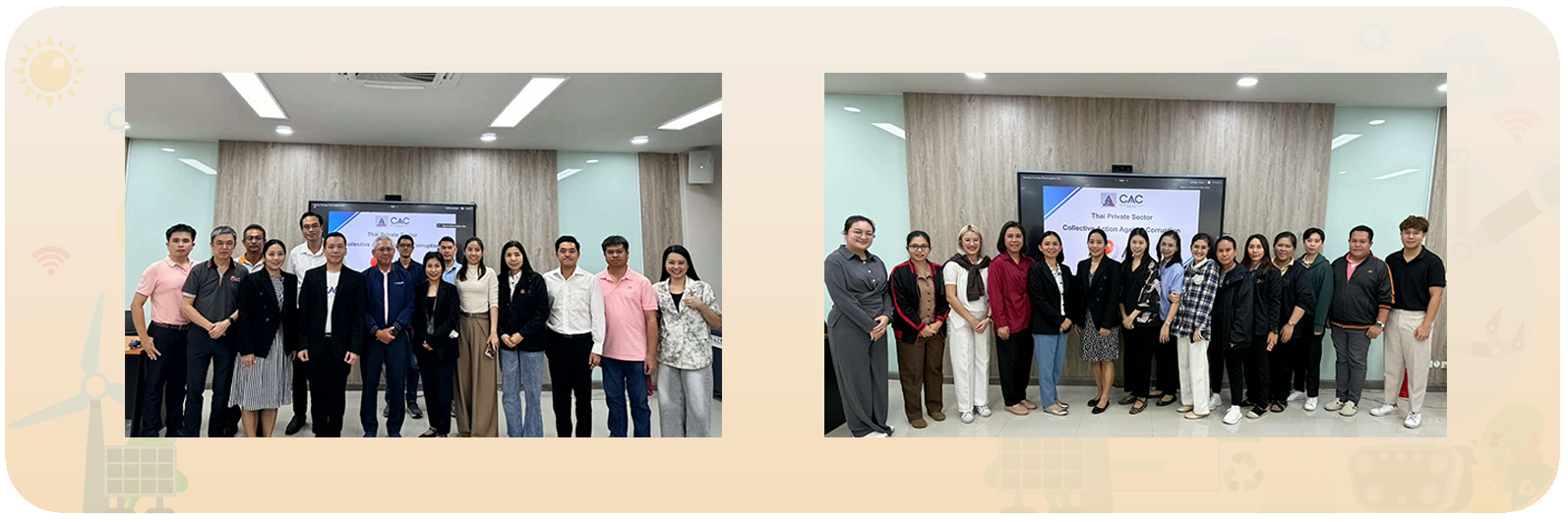
In addition, in 2025 the Company organized a Hybrid Training program on “Anti-Corruption” to enhance knowledge, understanding, and awareness among executives and employees regarding the importance of conducting business with transparency and integrity. The Company was honored to have distinguished speakers from the Thai Private Sector Collective Action Against Corruption (CAC), namely Mr. Pornhames Benjarongkit and Mr. Piny Siraprapasiri, who shared their knowledge and practical experiences. The training was conducted in two sessions: August 1, 2025 for executives and August 28, 2025 for employees. The program aimed to ensure that personnel at all levels clearly understand anti-corruption practices and are able to appropriately apply them in their work. This activity forms part of the Company’s preparation for participation in the Thai Private Sector Collective Action Against Corruption (CAC) and reflects the Company’s commitment to conducting business with transparency, adhering to good corporate governance principles, and maintaining zero tolerance for all forms of corruption.
Joined or Declared Intent to Join Anti-Corruption Networks
Yes
Networks & Projects Joined
| Network / Project | CAC Certified |
|---|---|
| Thai Private Sector Collective Action Against Corruption: CAC | N |
| United Nations Global Compact (UNGC) | |
| Participation of anti-Corruption networks and initiatives |
Material Changes & Developments in CG
Reviewed the CG Policy or Board Charter in the Past Year
Yes
Material Changes or Developments in the Past Year
Yes
Policy Review — Description
In the past year, the company has focused on enhancing its corporate governance in line with the good corporate governance principles of the Stock Exchange of Thailand and practices suitable for the nature of its information technology and digital infrastructure business.
The company has reviewed and revised its corporate governance policies and practices, including the charters of the Board of Directors and sub-committees, to provide greater clarity on roles, duties, and responsibilities. This covers key issues such as risk governance, internal control, compliance with laws and business ethics, as well as transparent and timely disclosure of information.
In 2025, the Company reviewed and enhanced its anti-corruption policies to prepare for declaring its intention to join the Thai Private Sector Collective Action Against Corruption (CAC). The Company also revised and improved relevant charters and regulations to ensure completeness, clarity, and alignment with the Corporate Governance Report (CGR) assessment criteria of the Thai Institute of Directors Association (IOD), as well as good corporate governance practices. These efforts aim to elevate governance standards and continuously strengthen the effectiveness of the Company’s anti-corruption framework.
Furthermore, it emphasizes building confidence among shareholders and stakeholders by encouraging the Board of Directors and management to operate under good corporate governance principles to promote the company's stable and sustainable long-term growth.
Implements the CG Code for Listed Companies
No
CG Code — Description
The Company remains committed to continuously adhering to the principles of good corporate governance, based on the philosophy of sufficiency and good governance. It strives to be a transparent and accountable organization, conducting business with due consideration for society, communities, and the environment, while promoting ethical conduct among personnel and enhancing employees’ quality of work life in order to achieve sustainable growth. The Company has disclosed its corporate governance practices in accordance with the CG Code and complies with the good corporate governance guidelines for listed companies issued by the Stock Exchange of Thailand. The Board of Directors reviews governance practices annually to ensure their appropriateness in light of the evolving business environment and requires regular monitoring of policy implementation to ensure effective adherence to governance principles.
The Company has applied key CG Code principles in a tangible manner, such as clearly defining the roles and responsibilities of the Board and management to ensure proper checks and balances; ensuring accurate, complete, and timely disclosure of information to enable shareholders to make informed decisions; upholding shareholders’ rights and equitable treatment; and maintaining appropriate risk management and internal control systems. Examples include the disclosure of related party transactions in accordance with prescribed rules and the annual performance evaluation of the Board of Directors to enhance governance effectiveness.
In addition, the Company has established the Corporate Governance and Sustainability Development Committee as a subcommittee responsible for overseeing, providing guidance, and setting practices in line with good corporate governance and sustainable development principles. The Committee promotes transparency and seeks to achieve balance across environmental, social, and governance (ESG) dimensions to strengthen confidence and credibility among stakeholders, while supporting the Company’s sustainable growth and long-term value creation.
Other CG Performance & Outcomes
For the year 2025, the Company received an "Excellent" (4-star) rating in the Annual Corporate Governance Assessment for Listed Companies 2025, conducted by the Thai Institute of Directors Association, surveying the corporate governance of 844 listed companies. Furthermore, the Company received the results of the 2025 Annual General Meeting of Shareholders Quality Assessment, organized by the Thai Investors Association. The Company scored 84.5 percent, reflecting that the Board of Directors prioritizes good corporate governance and consistently reviews and updates its practices.