

Board Performance · 2025
In this section15 topics
- Compliance Monitoring — Overview1 item
- Prevention of Conflicts of Interest3 items
- Prevention of the Use of Inside Information3 items
- Anti-Corruption4 items
- Whistleblowing3 items
- Selection of Directors & Chief Executives6 items
- Selection of Independent Directors2 items
- Director Development1 item
- Evaluation of Board & Subcommittee Performance3 items
- Subcommittees1 item
- Meeting Attendance & Remuneration5 items
- Supervision of Subsidiaries & Associated Companies4 items
- Board Duty Performance — Overview1 item
- Audit Committee Duty Performance1 item
- Executive Committee Duty Performance1 item
Compliance Monitoring — Overview
Monitoring of Compliance with Other CG Policies & Guidelines
The Board of Directors acknowledges and adheres to the CG Code and recognizes its role as a leader in creating sustainable value for the Company. The Board has conducted an overall assessment of the Company’s compliance with the CG Code and evaluates its implementation at least once a year. In 2025, the Board considered and reviewed this matter and duly recorded it in the minutes of the Board of Directors’ Meeting No. 6/2025. The Company regularly reviews its practices to ensure alignment with good corporate governance principles. For the year 2025, the Company complied with the CG Code, except for the following matter:
1. Independent directors should serve no more than nine years. The Company has three independent directors who have served for more than nine consecutive years: Mr. Pongthep Polanan, Mr. Sripop Sarasas, and Mr. Thanarak Pongphettra. Nevertheless, these independent directors possess extensive knowledge, expertise, and a strong understanding of the Company’s business. Throughout 2025, they have consistently provided valuable advice, recommendations, and strategic perspectives that benefit the Company’s operations. Moreover, their long tenure has enhanced their in-depth understanding of the Company’s business, organizational structure, and business environment, which supports effective corporate governance and informed policy decision-making.
Details of the tenure of the Company’s independent directors are as follows:
Name – Last Name | Appointed Date of the Independent Director | Year(s) : (Appointed date - Present) |
Mr. Thanarak Phongphatar | 5 April 2012 | 13 Years 8 Months |
Mr. Pongtep Polanun | 15 Febuary 2003 | 22 Years 10 Months |
Mr. Sripop Sarasas | 15 Febuary 2003 | 22 Years 10 Months |
2. The Nomination and Remuneration Committee should comprise entirely independent directors.
At present, the Company’s Nomination and Remuneration Committee consists of four members: two independent directors, one non-executive director, and one executive director. Mr. Pongthep Polanan, an independent director, serves as Chairman of the Nomination and Remuneration Committee. In performing its duties, the Committee has adhered to fair and transparent nomination and remuneration practices in line with good governance principles. The Committee also benchmarks remuneration against companies within the same industry as appropriate. Furthermore, the composition of the Committee supports a proper balance of power and promotes prudent deliberation, supported by a deep understanding of the Company’s business nature and operating context.
Prevention of Conflicts of Interest
Has the Company Acted to Prevent Conflicts of Interest?
Yes
Operations in the Past Year
The Company complies with relevant rules and regulations regarding the reporting of interests of directors, executives, and related persons, which are transactions that may cause a conflict of interest and compliance with good corporate governance principles. If any director has a stake or is involved in any agenda, that director shall abstain from voting on that agenda. The Board of Directors establishes criteria and methods for reporting interests of directors, executives, and related persons as follow:
1. The directors and the executives shall report their interests from their initial designation and any change in their interests within 7 working days in accordance with the report form for interests of directors and executives and submit the report to the corporate secretary to proceed and retain for audit purposes.
2. The corporate secretary shall submit the report of interests, and any change, to the chairman and audit committees within 7 working days from the date of receiving the said report and report to the Board of Directors in the next meeting.
3. At the end of the year, the Company secretary shall prepare a report on the conflict of interest and submit to the directors and executives for data verification or the purpose of disclosure in the Annual Registration Statement and the Form 561 One Report.
In 2025, the Company sent information to executives and employees via email to access the prepared system to build understanding regarding conflicts of interest. Additionally, executives and employees were required to electronically sign through the system for acknowledgment, with 100% of them signing and acknowledging this year. Furthermore, understanding was promoted for employees to operate according to the "Business Ethics Handbook" through the same system, with 100% of executives and employees electronically signing and acknowledging. In 2025, no directors, executives, employees, or related persons were found to have violated the conflict of interest policy.
Number of Conflict-of-Interest Cases
| Metric | Current Year | Previous Year | Two Years Ago |
|---|---|---|---|
| Total number of cases or issues related to conflicts of interest (cases) | 0 | 0 | 0 |
Prevention of the Use of Inside Information
Has the Company Acted to Prevent the Use of Inside Information?
Yes
Operations in the Past Year
Reporting changes in securities holdings and derivatives contracts under Section 59 of the Securities and Exchange Act requires directors, executives, and auditors of the issuing company to disclose reports on their own securities holdings and derivatives contracts, as well as those of their spouses and minor children. This is to enable investors to monitor the movements in securities holdings of such individuals who are in positions or statuses that may have access to inside information of the company and may benefit from such information before it is generally disclosed. In addition to these legal requirements, whenever there is a change in the securities holdings of directors or executives, this information will be presented as an agenda item for the Board of Directors' acknowledgment at every quarterly Board meeting. The Company requires directors and executives to refrain from trading the Company’s securities and derivatives for a period of one month prior to the announcement of the Company’s financial statements. Furthermore, the Company has a policy and is committed to ethical conduct, honesty, and integrity in conducting business with customers, partners, investors, and shareholders. Guidelines are stipulated in the Company's "Code of Conduct" manual under the topic "Use of Inside Information and Securities Trading" for directors, executives, and employees at all levels to adhere to and implement. Details can be found under the topic "Management of Inside Information Use," which is published on the Company's website. In 2025, no directors or executives were found to have traded the Company's securities.
Number of Inside-Information Cases
| Metric | Current Year | Previous Year | Two Years Ago |
|---|---|---|---|
| Total number of cases or issues related to the use of inside information to seek benefits (cases) | 0 | 0 | 0 |
Anti-Corruption
Has the Company Acted on Anti-Corruption?
Yes
Operations in the Past Year
The Company has a policy to treat its business partners equitably and fairly, with honesty and integrity, while strictly honoring its commitments to all stakeholder groups. The Company also recognizes the importance of preventing corruption both internally and externally. Accordingly, anti-corruption guidelines are clearly stipulated in the Company’s Code of Business Ethics to serve as a framework for directors, executives, and employees at all levels to adhere to.
In 2025, the Company continued to conduct its business with transparency, accountability, and in alignment with ethical principles and good corporate governance. The key practices are summarized as follows:
Review of appropriateness in anti-corruption
The Company has continuously reviewed the appropriateness of its anti-corruption operations, including revising and establishing relevant policies and procedures. These include improvements to the Anti-Corruption Policy, the Policy on Giving and Receiving Gifts, Entertainment and Other Benefits, and the Human Resources Management Policy related to anti-corruption practices. These efforts aim to strengthen good corporate governance standards and to prepare the Company for participation in the Thai Private Sector Collective Action Against Corruption (CAC).
These policies and practices were approved by the Board of Directors Meeting No. 5/2025 on November 5, 2025, and were communicated to executives and employees at all levels for strict compliance. The Company also promotes an organizational culture grounded in honesty, transparency, and zero tolerance for all forms of corruption, thereby strengthening stakeholder confidence over the long term.
Participation in Anti-Corruption Programs
The Company places great importance on conducting business transparently and free from corruption. In 2025, the Company declared its intention to join the Thai Private Sector Collective Action Against Corruption (CAC) on September 26, 2025, demonstrating its commitment to strengthening good corporate governance and anti-corruption practices across all aspects of its operations. The Company is currently in the certification process and has enhanced its policies, operational systems, and internal control measures to align with CAC requirements. The Company expects to obtain CAC certification in 2026, marking another significant milestone in strengthening stakeholder confidence and supporting sustainable organizational growth.
Communication and training for employees on anti-corruption policy and guidelines
The Company reviews its anti-corruption policies regularly to ensure they remain up to date. At the beginning of each year, executives and employees are formally informed of the policies. In 2025, 90.12% of executives and employees acknowledged and signed the Anti-Corruption Policy. On November 5, 2025, the Corporate Governance and Sustainability Committee Meeting No. 2/2025 reviewed and updated the Anti-Corruption Policy to ensure alignment with good corporate governance principles, in accordance with the requirement for annual review, and proposed it to the Board of Directors for approval. The Company also promotes the No Gift Policy regarding the giving or receiving of gifts, entertainment, or other benefits, reflecting its continuous commitment and emphasis on anti-corruption practices.
Form of Anti-Corruption Operations
| Operation |
|---|
| Review of appropriateness in anti-corruption |
| The participation in anti-corruption projects |
| Communication and training for employees on anti-corruption policy and guidelines |
Number of Corruption Cases
| Metric | Current Year | Previous Year | Two Years Ago |
|---|---|---|---|
| Total number of cases or issues related to corruption (cases) | 0 | 0 | 0 |
Whistleblowing
Has the Company Implemented Whistleblowing Procedures?
Yes
Operations in the Past Year
The Company has established a Whistleblowing and Complaint Handling Policy to provide all stakeholder groups with channels to report information, complaints, or concerns regarding actions that may violate laws, regulations, rules, the Company’s Code of Conduct, or principles of good corporate governance, in a secure and confidential manner.
In 2025, the Company reviewed and improved this policy to ensure greater alignment with Corporate Governance (CG) principles and the guidelines of the Thai Private Sector Collective Action Against Corruption (CAC). The revisions emphasize whistleblower protection, the provision of multiple, transparent, and auditable reporting channels, as well as the establishment of systematic and fair investigation and follow-up procedures.The revised policy was duly approved by the Board of Directors at Meeting No. 5/2025. The key contents are as follows:
The company has established “Whistleblowing and Complaint Policy” To provide an opportunity for directors, executives, employees, and all stakeholder groups of the company to report clues, complaints, or suggestions regarding violations of laws, regulations, rules, or business ethics, corruption, irregularities in financial reports, or deficiencies in the company's internal control system. Whistleblowers or complainants can submit clues or complaints along with supporting evidence through various channels as deemed appropriate, as follows:
1. By email: CGSD@ait.co.th or AC@ait.co.th
2. By website: https://www.ait.co.th/en/sustainability/whistleblowing
3. By mail: Send mail to
To the Chairman of the Corporate Governance and Sustainable Development Committee, or
Chairman of the Audit Committee
Advance Information Technology Public Company Limited
37/2 Sutthisan Winitchai Road, Samsen Nok Subdistrict, Huai Khwang District, Bangkok 10310
4. By telephone: 02-275-9400 # 3101 Secretary to the Anti-Corruption Working Group
Protection and Confidentiality for Whistleblowers or Complainants
The company values the privacy and security of whistleblowers or complainants and allows them to choose to remain anonymous if they believe that disclosure would lead to insecurity or any harm. However, if identity is disclosed, it will enable the company to report progress and clarify facts after the investigation.
The company will keep the information of whistleblowers or complainants and related data confidential, and will not disclose it to unauthorized persons, unless disclosure is required by the company's regulations or by relevant laws, rules, or regulations.
Operating Procedures
1. In cases where there is sufficient supporting evidence for the accusation or complaint, a full investigation will be initiated with the objective of ascertaining whether the alleged action actually occurred. The form of investigation will vary depending on the circumstances. The investigation will be conducted under strict confidentiality. Whistleblowers or complainants may be contacted for additional information.
2. The investigation committee will inform the whistleblower or complainant (if their identity is disclosed) of the progress and clarify the facts after the investigation results are concluded, through appropriate communication channels, and will keep all related files confidential. In important cases, the Board of Directors will be informed.
3. The Anti-Corruption Risk Management Committee will re-evaluate corruption risks to ensure adequacy and effectiveness after an investigation reveals an act of corruption.
Penalties
Anyone who intentionally or negligently fails to comply with this policy, including engaging in harassment, intimidation, disciplinary action, or discrimination through improper means due to a complaint made by a whistleblower/complainant or persons involved in a complaint under this policy, shall be considered to have committed a disciplinary offense. The company will consider penalties in accordance with company regulations, and if the act violates the law, the company will also consider legal action in accordance with relevant laws.
False Whistleblowing or Complaints
If the company finds that the whistleblowing, complaint, or any statement or information provided is proven to be an act of bad faith, false, and intended to cause damage, in the case of an employee, disciplinary action will be taken in accordance with the company's regulations. However, if it is an external party whose actions cause damage to the company, the company will consider legal action against such individuals in accordance with relevant laws, as appropriate for each case.
Policy Review
The Corporate Governance and Sustainable Development Committee will review the Whistleblowing Policy and guidelines annually and submit them to the Board of Directors for acknowledgment. If significant amendments are made to the policy, they will be submitted to the Board of Directors for approval, to ensure that the policy complies with relevant laws, is effective, and aligns with the company's regulations.
Number of cases/complaints of business ethics violations or corruption in 2025
Number of Ethical Misconducts | 0 Cases |
Number of Corruption Offenses | 0 Cases |
Number of directors resigned due to corporate governance issues of the company | 0 Cases |
Number of complaints or reported incidents concerning customer personal data protection | 0 Cases |
Number of Whistleblowers and Complaints Received | 0 Cases |
Number of Whistleblowing Cases
| Metric | Current Year | Previous Year | Two Years Ago |
|---|---|---|---|
| Total number of cases or issues received through whistleblowing channels (cases) | 0 | 0 | 0 |
Selection of Directors & Chief Executives
Directors & Chief Executives — Introduction
1. Guidelines for nomination and qualifications of directors
Nomination and Appointment of Directors
Appointment of the Directors shall be determined by many qualifications such as knowledge, skills, and experience related to the business. The Nomination and Remuneration Committee is responsible for review of the qualifications and performances of the candidates in appointment of the Directors.
The Board of Directors is well aware of the benefits of the diversity of the Board of Directors and has developed a Skill Matrix for the Board of Directors and focus on transparency in the nomination of the candidates, without restrictions on gender, age, education, race, nationality, religion, professional experience, skills and knowledge or any other differences. The Nomination and Remuneration Committee is responsible for review of the qualifications and performances taking into account the benefits of the diversity of candidates or directors who retire by rotation or resign. The Nomination and Remuneration Committee also considers necessary skills that are lacking in the Board of Directors in order to be in line with the Company's business strategy and propose it to the Board of Directors for an approval. After that, the list of proposed directors will be proposed to the shareholders' meeting to elect the directors.
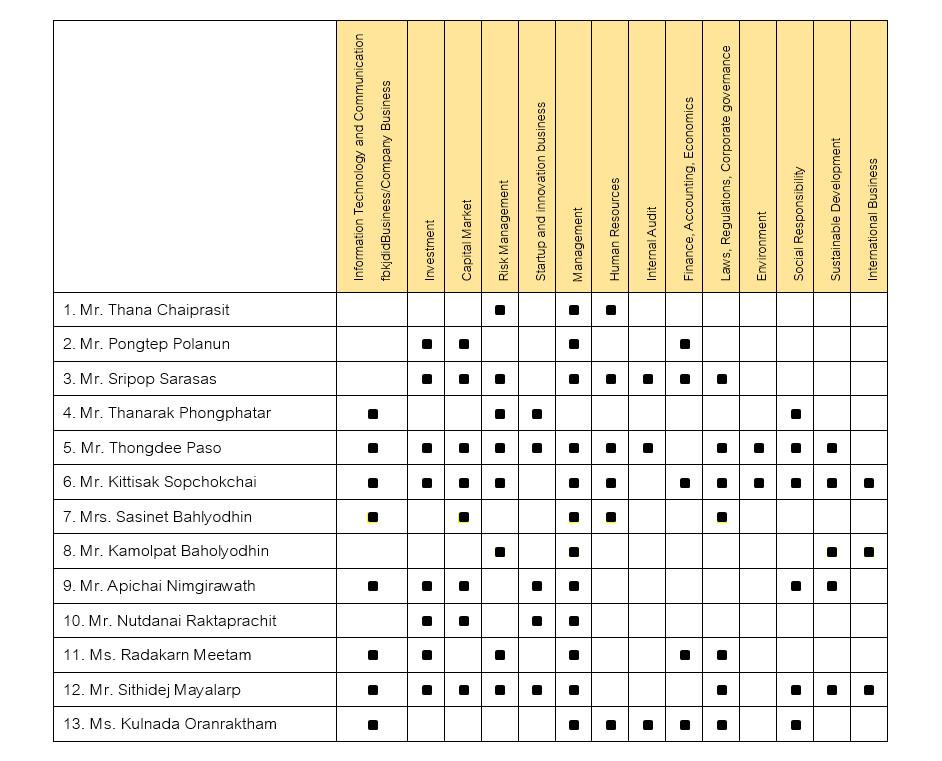
2. The Nomination of key management positions and Succession plan
The Board of Directors recognizes that employees are key driving force of the quality organization. The challenge for the business is a building personnel with knowledge and ability which readiness to keep pace with sustainable business expansion. In addition, they have inherited the spirit of the founder including the culture of the organization from generation to generation. Thus, the Company has developed a policy encourages the managements to enhance personnel development in an efficient way to achieve the vision, mission and values.
The Company has recruited eligible persons to responsible for key management positions at all levels in accordance with the qualifications as proper and transparency, and to ensure that the Company has recruited executives with professionalism, neutrality and non-involvement in politics. They also understand the culture and conduct of the business of the company. The company has a well-defined succession plan follows.
1. The President/ Managing Director
The Nomination and Remuneration Committee will identify qualified candidates for the President and submit the chosen candidate to the Board of Directors for consideration and approval as part of the recruitment, selection, and succession plan. In the event that the President position becomes vacant or the incumbent is unable to fulfill his/her duties, the Company will designate an executive at a comparable or lower level to serve as acting the President until a candidate who meets the qualifications set by the Company identified and chosen. Candidates must possess the vision, expertise, experience, and understanding that align with the Company’s corporate culture. The Nomination and Remuneration Committee will consider and propose to the Board of Directors for approval to appoint suitable persons as the President.
2. Senior Executive Vice President
When the Senior Executive Vice President becomes vacant or the incumbent is unable to fulfill his/her duties, the Company will propose the selected successor for consideration by the Executive Committee for approval and then to the Board of Directors for acknowledgement.
3. Key positions in the Company
A key position is one that will affect the operations of the Company. Executives or staff in this position must possess a high degree of skill, knowledge, and expertise. If a key position becomes vacant, the Company will propose the selected successor to the Board of Directors for review and approval.
The details of the Company’s succession plan are as follows:
1. Analyze the Company’s business situation in terms of strategy, policy, investment plan, business expansion plan
2. Assess the workforce availability in accordance with the Company’s strategy in both short-term and long-term.
3. Create a plan to increase workforce availability by hiring new staff members and fostering employee growth to replace departing ones.
4. Prepare a recruitment plan and an employee training and development in advance prior to an employee retiring or leaving their job early.
5. Determine the qualifications and competencies, in terms of knowledge, skills, personality and attitudes required for the role in accordance with the corporate culture and create an individual development plan.
6. Select the candidates, then assess their performance and potential to make sure they are qualified.
7. Analyze the potential of the candidates by using personnel testing and assessment tools.
8. Identify the successor to the position based on the evaluation and analysis of the employee’s potential and performance. The chosen successor is informed in advance so they may be ready for the transition and become familiar with the job. After that, a backup successor is identified.
Are Directors Selected Through the Nomination Committee?
Yes
Are Chief Executives Selected Through the Nomination Committee?
Yes
Number of Directors from Major Shareholders
3
Rights of Minority Shareholders on Director Appointment
The criteria and procedures of selecting the directors are set to be determined in shareholders’ meeting by counting the majority votes in accordance with the following criteria and procedures;
1. Each shareholder shall have one vote per one share.
2. Each shareholder shall use his or her vote according to (1) to elect one or several directors. However, dividing the votes is not possible.
3. The candidate with the highest votes will be elected as the directors, where the number of elected directors is equal to the required directors of each time. In the case of the elected candidates have equal votes and the numbers of directors are over the requirement, the President shall have a casting vote.
Method of Director Appointment
| Method |
|---|
| Method whereby each director requires approval votes more than half of the votes of attending shareholders with voting rights |
Selection of Independent Directors
Criteria for Selecting Independent Directors
In 2025, the Company has independent directors as follows:
Name – Last Name | Position |
1. Mr. Thana Chaiprasit | Independent Director |
2. Mr. Pongtep Polanun | Independent Director |
3. Mr. Sripop Sarasas | Independent Director |
4. Mr. Thanarak Phongphatar (Resigned during the year 2025) | Independent Director |
5. Mr. Thongdee Paso (Resigned during the year 2025) | Independent Director |
6. Mr. Pathrlap Davivongsa | Independent Director |
Independent Directors are defined as Directors who do not hold any management position and are not employees of the Company or Subsidiary. They must additionally be independent of any major shareholders, management, and of any other related persons and they must have the responsibility to determine if there is anything that may affect the equitable treatment of Shareholders. The qualifications to be an Independent Director are as follows:
1. Holds not more than 1% the total voting shares of AIT, its parent company, its subsidiaries, its associated companies, major shareholders or a controlling person including stocks that held by related persons of the Independent Director;
2. Is not, or has not ever been an executive director, employee, staff member, or advisor who received a salary or a controlling person of AIT, its parent company, its subsidiaries, its associated companies, major shareholders or a controlling person unless the foregoing status has been ended for at least 2 years. This shall not include the Independent Director who used to be a government official or advisor of a government agency which was a major shareholder or acted as controlling persons of AIT;
3. Is not a person that related to blood or legal registration, such as father, mother, spouse, sibling or child, including a spouse of the children, managements, major shareholders, controlling persons, or persons to be nominated as management or a controlling person of AIT or its subsidiaries;
4. Has not, or has not had a business relationship with AIT, its parent company, its subsidiaries, its associated companies or a controlling persons in the manner that may interfere with their independent judgement, or is not, or has not ever been, a major shareholders, managements or controlling persons of any person having a business relationship with AIT, its parent company, its subsidiaries, its associated companies or controlling person unless the foregoing relationship has been ended at least 2 years;
5. Has not, or has not ever been, an auditor of AIT, its parent company, its subsidiaries, its associated companies or a controlling persons and is not a major shareholders, nonindependent directors, managements, controlling persons or partner of an audit firm which employs auditors of AIT, its parent company, its subsidiaries, its associated companies or a juristic person who may have a conflict of interest unless the foregoing relationship has been ended for at least 2 years;
6. Has not, or has not ever been, any professional advisor including legal or financial advisor who received an annual service fee exceeding Baht 2 million from AIT, its parent company, its subsidiaries, its associated companies or a controlling persons, and is not a major shareholders, nonindependent directors, managements, controlling persons or partner of the professional advisor unless the foregoing relationship has been ended for at least two (2)years;
7. Does not represent as an AIT Board Member or its major shareholders or a shareholders who related to major AIT shareholders;
8. Does not operate any business similar to, or materially competing with AIT or its subsidiaries or not being a material partner in any partnership, executive director, employee, staff, advisor who receives salary or holds more than 1% f total voting shares of the Company which operates similar to, or materially competing business with AIT or its subsidiaries;
9. Has no characteristics which make incapable of expressing independent opinions with regard to the AIT business.
The definition of independent directors is the same as the minimum requirements of the SEC. or the SET. The Independent directors shall not hold shares exceeding 1% of the total number of voting shares of the Company
Did Any Independent Director Have a Business or Professional Relationship?
No
Director Development
Qualifications for Director Selection — Introduction
Qualifications of Directors
The person who will be appointed as the Company’s Director must meet the qualification by considering the knowledge, ability, personal talent as the following qualifications;
1. To have the qualifications with no prohibited characteristics as specified by the Act of Public Company Limited, including have no manner indicating a lack of trustworthiness to manager the company from the reviews of shareholders according to the Securities and Exchange Commission and the Stock Exchange of Thailand regulations.
2. To have knowledge, skill or experience in the ICT industry or accounting, finance or business administration or any other field as the Board deems appropriate.
3. To devote time especially for making key decision and responsibility duties for the beneficial for the Company and be able to participate in all the Board and Shareholder’s Meetings, unless unable due to a necessity or unexpected emergency.
4. To have a moral, ethical, and any other qualifications that meet the requirement of law or deemed appropriate by the Board.
Evaluation of Board & Subcommittee Performance
Criteria for Evaluating Board Performance
The Company conducts an annual performance evaluation of the Board of Directors and its sub-committees to assess the efficiency of the Board's operations in accordance with good corporate governance principles. This also allows the Board to review its performance, issues, and obstacles over the past year, and to utilize the evaluation results to improve the Board's duties. The evaluation criteria for both the entire Board and individual directors cover 6 topics: Board structure and qualifications, roles, duties, and responsibilities of the Board, Board meetings, performance of directors, relationship with management, and self-development of directors and executive development. A five-level rating scale is applied for each criterion as follows:
5 = Excellent / Implemented at the highest level
4 = Very good / Well implemented
3 = Moderate / Adequately implemented
2 = Low / Slightly implemented
1 = Very low / Not implemented
Evaluation of Board Performance in the Past Year
In 2025, the Company Secretary distributed performance evaluation forms including evaluation forms for the Board of Directors, the Audit Committee, the Nomination and Remuneration Committee, the Corporate Governance and Sustainable Development Committee, and the Executive Committee, for the purpose of evaluating the performance of the entire Board and individual directors. The summary of the performance evaluation results for the Board and its sub-committees.
Evaluation Results
| Evaluated Body | Group — Carried Out? | Group — Grade / Average Score | Group — Grade / Full Score | Individual (Self-Assessment) — Carried Out? | Individual (Self-Assessment) — Grade / Average Score | Individual (Self-Assessment) — Grade / Full Score | Cross (Assessing Other Directors) — Carried Out? |
|---|---|---|---|---|---|---|---|
| Board Of Director | Y | 95 | 100 | Y | 96 | 100 | N |
| Audit Committee | Y | 96 | 100 | Y | 96 | 100 | N |
| Other Subcommittee | Y | 96 | 100 | Y | 98 | 100 | N |
| Other Subcommittee | Y | 94 | 100 | Y | 97 | 100 | N |
| Executive Committee | Y | 96 | 100 | Y | 97 | 100 | N |
Subcommittees
Subcommittees
| Results of the Subcommittee's Duty Performance |
|---|
The Nomination and Remuneration Committee is responsible for considering and determining remuneration, and presenting it to the Board of Directors for submission to the shareholders' meeting. If the shareholders deem it appropriate, taking into account the expected benefits from the directors and being comparable to the same industry, they will approve it as proposed by the Board of Directors. The Company has a policy to set director remuneration at a level comparable to other companies in the same industry, to attract and be commensurate with the directors' knowledge, abilities, and responsibilities. In 2025, the Company’s Nomination and Remuneration Committee consisted of four members, comprising two independent directors and two directors. During the year, the Committee held two meetings. A summary of its key activities is as follows: 1. Nomination, Selection, and Appointment of Qualified Persons - Chairman of the Executive Board and President The Nomination and Remuneration Committee considered and nominated individuals possessing diverse qualifications in terms of skills, experience, knowledge, capabilities, and specific expertise necessary to achieve the Company’s objectives and goals. The selected candidate demonstrates expertise aligned with the Company’s business strategy and is qualified in accordance with applicable laws and regulations to assume the position of Chairman of the Executive Board and President, with effect from January 1, 2026 onward. - Directors in Replacement of Those Retiring by Rotation and Appointment of a New Director in Replacement of a Deceased Director The Committee reviewed the list of directors and audit committee members due to retire by rotation in 2025, nominated directors to replace those retiring by rotation, and appointed a new director to replace a deceased director. The nomination process was conducted by considering qualified candidates from the director pool database of the Thai Institute of Directors Association (IOD). The recruitment and selection process was carried out in compliance with applicable laws, regulations, and the requirements of the Stock Exchange of Thailand, taking into account qualifications, experience, knowledge, and capabilities beneficial to the Company, as well as ensuring continuity in governance and business operations. The proposed nominees were submitted to the Board of Directors for approval prior to being presented to the Annual General Meeting of Shareholders for further approval. 2. Determination of Directors’ Remuneration The Nomination and Remuneration Committee considered the determination of directors’ remuneration, including monthly remuneration, meeting allowances for 2025, and annual bonuses for 2024, for the Board of Directors and its sub-committees, namely the Board of Directors, the Audit Committee, the Nomination and Remuneration Committee, and the Corporate Governance and Sustainability Committee. The proposed remuneration was submitted to the Board of Directors for approval prior to being presented to the Annual General Meeting of Shareholders for consideration and approval. The remuneration was determined based on appropriateness and alignment with the Company’s operating performance and must be comparable to that of listed companies of similar size and within the same industry. 3. Determination of Salary Increase Rates and Annual Bonus |
The Corporate Governance and Sustainable Development Committee was established to strengthen the company's plans and standards for adhering to good corporate governance principles, as well as to enhance and concretize sustainable development. Furthermore, it aims to consolidate the components, responsibilities, and operational guidelines assigned by the Board of Directors, enabling the Corporate Governance and Sustainable Development Committee to oversee, advise, and establish appropriate and transparent operational guidelines in accordance with the company's good corporate governance and sustainable development principles. This includes creating a balance in environmental, social, and governance (ESG) aspects to build confidence and credibility among stakeholders, and to ensure the company's organizational management grows and creates sustainable value for all stakeholders. Meetings are held at least once a year, and relevant management, executives, employees, or other appropriate individuals may be invited to attend meetings to provide opinions or submit relevant or necessary documents. In 2025, the Corporate Governance and Sustainability Committee consisted of three members, comprising two independent directors and one qualified expert appointed by the Board of Directors. During the year, the Committee held three meetings. A summary of its key activities is as follows: 1. Good Corporate Governance - Considered and endorsed the Company’s participation in the Thai Private Sector Collective Action Against Corruption (CAC) to enhance good corporate governance practices and strengthen confidence among all stakeholder groups. - Reviewed and updated the anti-corruption policy, whistleblowing policy, accepting and offering of Gifts, hospitality or other policy, human resources policies related to anti-corruption policy, as well as the Code of Conduct, including relevant procedures concerning anti-corruption practices. - Reviewed and enhanced the Company’s corporate governance practices to ensure alignment with the principles of good corporate governance for listed companies and best international practices. In 2025, the Company received an “Very Good”CGR Checklist rating from the Thai Institute of Directors Association. - Encourage communication of corporate governance policies and practices to employees at all levels, supervised compliance with the anti-corruption policy, and fostered a transparent organizational culture. 2. Sustainable Development - Monitored and continuously reviewed the Company’s environmental performance, covering energy management, water management, waste management, electronic waste, waste disposal and end-of-life product management, and greenhouse gas management, in order to assess readiness for the establishment of clear and measurable quantitative targets going forward. - Monitored, oversaw, and reviewed the progress of the Sak forest for carbon credits project, which plays a significant role in reducing and offsetting greenhouse gas emissions arising from the Company’s operations, while supporting emission reduction efforts and fostering the Company’s long-term sustainable growth. |
Meeting Attendance & Remuneration
Meeting Attendance — Introduction
The Board of Directors has policy to schedule Board’s meetings at least five (5) meetings throughout the year. The meetings are normally pre-scheduled for the entire year and informed to the entire Board. The Board of Directors shall meet with a pre-determined schedule or a special meeting that may be called by the Chairman if it necessary. Each meeting shall comprise of directors more than 50 % of total directors. A Board of Directors’ member unable to attend a meeting shall inform the Company approximately one to two (1 - 2) days prior to that meeting. To consider the significant matter, each Board meeting requires a quorum of two-thirds of directors to participate. To facilitate all Directors in the meeting, the Company organizes the meeting at the Company’s head office. However, since the Public Limited Companies Act has been amended to become the Public Limited Companies Act (No.4) B.E. 2022, which adds legal principles related to meetings via electronic media. As a result, in 2025 the Company organized meetings of the Board of Directors and sub-committees through all electronic device. The meeting invitation letter includes a clear meeting agendas and supporting meeting documents will be set in advance, which will be delivered to all directors at least seven (7) days prior to the meeting so that each director shall have sufficient time to analyze the information in advance. However, in a case of urgency this may not always be possible. Each meeting will be recorded and the approved documents will be gathered for reference or future review or investigation.
During the meetings, the Chairman allocates sufficient time for the consideration of the Company’s operating results after the Company’s auditor has reviewed or audited and certified the financial statements. The Chairman also ensures that directors have adequate opportunity to discuss, raise questions, and provide recommendations on key matters to management. All directors are free to express their opinions independently and openly.
Meeting Attendance — Remark
Types of Remuneration of the Board of Directors
The Nomination and Remuneration Committee will propose the renumeration results to the Board of Directors for consideration and then propose it to the Annual General Meeting of Shareholders for approval. In 2024, the compensation for directors and the sub-committees received approval resolutions from the 2024 Annual General Meeting of Shareholders according to the table below as follows:
Directors’ remuneration policy in 2025
Director | Monetary Remuneration (Baht) | ||
Monthly Retainer | Meeting Allowance | Annual Pension | |
The Board of Directors | |||
Chairman | 30,000 | 30,000 | / |
Member | 18,000 | 22,000 | / |
The Audit Committee | |||
Chairman | 35,000 | 30,000 | X |
Member | 30,000 | 25,000 | X |
The Nomination and Remuneration Committee | |||
Chairman | X | 30,000 | X |
Member | X | 25,000 | X |
The Corporate Governance and Substainable Development Committee | |||
Chairman | X | 30,000 | X |
Member | X | 25,000 | X |
Remuneration of the Board of Directors
Remuneration or Benefits Payable to the Board
| Metric | Amount (Baht) |
|---|---|
| Remunerations or benefits pending payment to the board of directors over the past year (baht) | 0 |
Supervision of Subsidiaries & Associated Companies
Does the Company Have Subsidiaries or Associated Companies?
Yes
Is There a Mechanism for Overseeing Subsidiaries and Associated Companies?
Yes
Mechanism for Overseeing Management of Subsidiaries
The Company has a mechanism in place to supervise, support, promote and drive the operations of subsidiaries and joint ventures to be efficient, transparent and work processes in accordance with the principles of good corporate governance. In 2024, the Company has one (1) subsidiary (Carbonlead Co., Ltd.), one (1) associated company (Zero CO2 PCL), one (1) joint venture (Loxley & AIT Holding Co., Ltd.), two (2) companies that have invested in non-listed equity instruments (Campana Group Pte. Ltd. and Blue Green Solution Co., Ltd.) and four (4) Joint operation (AWD Joint Venture, SA Joint Venture, AA Joint Venture, AAC Joint Venture). The Company has been appointed the executives to closely monitor the Company’s operations and appointed the senior executives as directors to oversee the returns on the Company’s investments.
Mrs.Sasinet Baholyodhin | Mr.Apichai Nimgirawath | Ms.Sureerat Prachayanukul | Mr.Suraporn Raktaprachit | Mr.Promporn Kedutat | |
The Company | |||||
| / // | / // | // | - | - |
Subsidiary | |||||
| / | - | / | - | - |
Associated Company | |||||
| - | - | / | - | / |
Joint Venture | |||||
| - | - | / | - | - |
Non-listed equity instruments | |||||
| - | - | - | / | - |
| - | - | - | - | - |
Joint operation | |||||
| - | - | - | - | - |
| - | - | - | - | - |
| - | - | - | - | - |
| - | - | - | - | - |
/ = Director // = Executive Board Director X = Chairman
Oversight Mechanisms
| Mechanism |
|---|
| Sending representatives to act as directors, executives or controlling persons in proportion to shareholdings |
| Defining the scope of powers, duties and responsibilities of directors and executives who represent the company in setting important policies |
| Disclosure of financial information and operating results |
| Transactions between the Company and related persons |
| Acquisition or disposal of assets |
| Internal control system of the subsidiary operating the core business is appropriate and sufficient in the subsidiary operating the core business |
Board Duty Performance — Overview
Section Introduction
The Board of Directors is responsible for determining the Company’s objectives and for defining the roles, duties, and delegated authorities of the Audit Committee, the Nomination and Remuneration Committee, the Corporate Governance and Sustainability Committee, and the Executive Committee. The Executive Committee is responsible for formulating policies, directions, and business strategies in alignment with the established objectives. The Audit Committee reviews the Company’s operations to ensure compliance with applicable laws and regulations. Meanwhile, the Nomination and Remuneration Committee considers the remuneration of the Company’s directors, members of subcommittees, the President, or other persons appointed by the Board of Directors, including the overall consideration of management and employee compensation in the form of bonuses and annual salary adjustments, and subsequently proposes such matters to the Board of Directors for approval or acknowledgment. The Corporate Governance and Sustainability Committee provides oversight, advice, and guidance to ensure that the Company’s practices in corporate governance and sustainable development are appropriate and transparent. In addition, the Board of Directors places importance on continuously monitoring the progress of the Company’s strategic plan implementation. The Executive Committee is required to report operational performance and progress of the plans to the Board of Directors on a quarterly basis. This enables the Board to effectively supervise, monitor, and provide appropriate guidance to ensure that the Company’s operations remain aligned with its strategic direction and objectives.
The Board of Directors has stipulated that Board meetings shall be held at least five (5) times per year. Meeting dates are scheduled in advance for the entire year and notified to all directors. In special circumstances, the Chairman may call additional meetings as necessary. Each meeting requires the attendance of more than 50 percent of the total number of directors. In cases where a director is unable to attend, the Company must be notified approximately 1–2 days in advance. The quorum required at the time of voting must consist of no fewer than two-thirds of the total number of directors. The Company has taken into consideration the convenience of directors by arranging meetings at the Company’s headquarters. However, following the amendment to the Public Limited Companies Act (No. 4) B.E. 2565 (2022), which introduced provisions regarding electronic meetings, in 2025 the Company conducted all Board and subcommittee meetings via electronic means. Meeting agendas are clearly defined and accompanied by adequate supporting documents, which are delivered together with the meeting invitation to all directors at least seven days prior to the meeting, allowing sufficient time for review, except in urgent circumstances. In addition, the Company records minutes of meetings and maintains duly certified reports and supporting documents for reference and verification. During meetings, the Chairman allocates sufficient time for the consideration of the Company’s operating results after the Company’s auditor has reviewed or audited the financial statements, and to allow directors to discuss, inquire, and provide recommendations on key matters to management. All directors are independent in expressing their opinions openly.
Audit Committee Duty Performance
Results of the Audit Committee's Duty Performance in the Past Year
For the fiscal year 2025, the Audit Committee performed its duties as assigned by the Board of Directors, in accordance with the Audit Committee Charter, good corporate governance principles, and the regulations of the Securities and Exchange Commission and the Stock Exchange of Thailand, upholding independence, transparency, and prioritizing the best interests of the company and its shareholders.
The Audit Committee has performed the following:
1. Review of Financial Statements
The Audit Committee reviewed the quarterly and annual financial statements prior to proposing them to the Board of Directors for approval. The Committee inquired and received clarifications from management and the external auditor regarding the accuracy, completeness, and adequacy of disclosures, subsequent events after the reporting period, and accounting adjustments that could have a material impact. This was to ensure that the preparation of the financial statements complied with applicable laws and financial reporting standards.The Audit Committee is of the opinion that the Company’s financial statements are accurate, reliable, and contain adequate and timely disclosures for the benefit of users of the financial statements. No material irregularities were identified.
2. Review of the Internal Control System
The Audit Committee reviewed the effectiveness and adequacy of the Company’s internal control system in collaboration with D I A Audit Co., Ltd., which serves as the internal auditor. Mr. Apinan Sripramote is responsible for the internal audit function and reports directly to the Audit Committee. The Committee also conducted joint reviews with management at the Deputy Managing Director level of each relevant division. The review was based on the 2025 internal audit reports, which were presented in four meetings and covered a total of eight audit areas, as follows: 1). Inventory management control system 2). Enterprise risk assessment 3). Cost of sales recognition and recording control system 4). Payroll disbursement control system 5). Accounts receivable and debt collection control system 6). Operational procedures of the Project Management Department 7).Pre-sales and after-sales expense control system and 8).Following up on results from previous internal audits
The Audit Committee continuously reviewed and monitored the implementation of the internal auditor’s recommendations in order to identify root causes and propose preventive measures against potential damages. The Committee also followed up to ensure that management implemented corrective actions and improved the internal control system to prevent recurrence. The Audit Committee is of the opinion that the Company’s internal control system is adequate, appropriate, and effective at an acceptable level.
3. Review and Oversight of Connected Transactions / Related Party Transactions
The Audit Committee reviewed and provided opinions on connected transactions and related party transactions on a quarterly basis. The review covered the disclosure of the following information: (1) names of the persons entering into the transactions; (2) relationship; (3) nature of the transactions and conditions; and (4) pricing policy and transaction value. In this regard, the Committee adhered to the principles of reasonableness, transparency, and arm’s length basis comparable to normal commercial transactions. Based on the review conducted in 2025, the Audit Committee is of the opinion that management carried out such transactions in the best interests of the Company, under reasonable terms and pricing, and in the ordinary course of business.
4. Consideration of the Appointment of External Auditor
The Audit Committee considered the appointment of the external auditor and proposed the auditor’s remuneration for the year 2025 for submission to the Board of Directors, in order to seek approval from the 2025 Annual General Meeting of Shareholders. Having considered the auditor’s performance, independence, and the appropriateness of the proposed audit fee, the Audit Committee deemed it appropriate to propose the appointment of Mr.Kitti Techakasembundit, Certified Public Accountant No. 9151, and/or Mrs. Kingkarn Asawarangsarit, Certified Public Accountant No. 4496, and/or Ms.Yujira Tuaton, Certified Public Accountant No. 10725, of EY Office Limited as the Company’s external auditor for the year 2025, as it is recognized for its auditing standards and professional expertise, and its ability to provide appropriate and clear advice on accounting standards. In addition, the auditor has no relationship or conflict of interest with the Company, its management, major shareholders, or related persons, thereby maintaining independence in performing the audit. In 2025, the Company’s annual audit fee amounted to Baht 2,000,000 (Two Million Baht Only), representing an increase of 5.3% from 2024, which is considered reasonable and appropriate.
Executive Committee Duty Performance
Results of the Executive Committee's Duty Performance in the Past Year
In 2025, the Executive Committee convened a total of 11 meetings. The Committee performed its duties and responsibilities in accordance with its charter and carried out tasks as assigned by the Board of Directors, as summarized below:
1. Consider and screen the company's business plan, annual budget plan, and investment plan for submission to the Board of Directors for approval.
2. Oversee the company's operations to ensure compliance with various plans, as well as compliance with laws, company rules and regulations, and the regulations of the Stock Exchange of Thailand.
3. Oversee that the company has appropriate and robust internal control operating systems and that they comply with the recommendations and observations of the Audit Committee.
4. Perform other duties as assigned by the Board of Directors.
5. Prepare reports on the company's operational performance and submit them to the Board of Directors for acknowledgment every quarter.